
Author name: Cecilia D’Cunha

Business Growth

Why continuous learning, professional and personal development is the key to success

During my recent travels to the USA, Canada, India, and Bahrain, I had the opportunity to meet. some of the world’s top real estate managers and I was very impressed with their professionalism, knowledge, and experience. Despite each of these persons being from different countries, environments and educational institutes. They stand out as top professionals in the business key to success. It begs the question, why do some professionals, regardless of their nationality or background become more successful and end up with a better career than others? It is very evident that those who don’t stop at what they have achieved or rest on their laurels are visibly. Making a difference with their contributions and are leading the industry to newer dimensions every day. Some may claim that the key to success for those individuals had the benefit of a better education. Graduated from the world’s top universities or they had mentors and friends that helped them get to where they are key to success. While there is no doubt that quality education, additional coaching, mentoring and connections do help, I can assure you that I have met many with none of that and yet succeeded. So how did they achieve this and what can we do to achieve the same? Here are some tips for you on how to become successful Continuous learning and development key to success The celebrated speaker and author Brian Tracy was right when he said that ”Continuous learning is the minimum requirement for success in any field.” I firmly believe that continuous learning and development is the key and is not acquired by chance – it must be attempted ardently and carefully. The world has changed since we have left our universities and it keeps changing daily. We need to change and adapt, learn and adapt. If we resist learning, we resist growing, we place ourselves in a situation where we and our capabilities can be underestimated. Evolving from formal academic qualifications to building credentials requires one to place importance in incessant learning and professional development. We need to be competitive – we are designed to be competitive, that’s how we got where we currently are – that’s how we will create consistent and successive triumphs for ourselves and that’s how to become successful key to success. key to success Learning programs – offline and online Today, thanks to the onslaught of digital technology, the ubiquitous smartphone, and tablet, there are a plethora of online courses and programs around us in our specific field of work. I am particularly fond of LinkedIn, as this platform has some great courses that one can enroll in and as a premium member it costs us nothing. There are other great online platforms like Edex, The Open University and Udemy where courses are either free or available at a very nominal charge. There are also a whole host of free videos on YouTube and if we want to go that extra mile and earn top credentials then almost every large institute. and university including the Ivy League ones like Yale, Harvard and Stanford have distance learning programs for working professionals. Plenty of schools, colleges, institutes, and universities in our local area will offer executive education, evening classes, workshops, and seminars. Simply said, we can learn almost anything we want to at the price we are most comfortable with and at the time of our choosing. The important thing is that we keep learning. Networking with peers and gurus Networking with peers and especially successful ones is one great way of learning about not only the business but its social aspects. Getting in touch with the gurus of our industry helps us get deeper insights into the profession and learn from the depths of their experience. We can meet such gurus and leaders at conferences, seminars, masterclasses, and workshops. My association with the gurus of my industry in my formative years has been instrumental in others considering me a guru as well. For those of us who are shy or may not know how to get started, there are many networking groups available online and offline. LinkedIn Groups, Meetup.com groups, and other such platforms connect us with like-minded professionals, and it doesn’t take long to find professional groups in our locality or city. The Dubai Community Managers for example regularly meet on the Last Thursday of every month in a local pub or restaurant. I have been hosting these for several years and it has always been quite popular. There are groups available for every profession one can think. Sometimes a simple Google search will reveal them. Joining an Institute or Chapter Every profession out there has some kind of institute, club or platform to bring its professional industry together. For real estate management professionals specifically, there are international organisations like the Community Associations Institute, the Institute of Real Estate Management (IREM), the International Facility Management Association(IFMA), CoreNet, FIABCI and many other international bodies that have large membership that cater to very specific aspects of the real estate management spectrum. For CX professionals, the Customer Experience Professionals Association (CXPA) a global non-profit organization dedicated to the advancement and cultivation of the CX profession is quite popular. The Customer Service Institute of America is a body that serves the needs of American CX professionals while the Institute of Customer Service focusses on the UK market. Similarly, there are institutes and chapters for every profession one can think of. Joining these can have a very dramatic effect on our professional future. Volunteering and Service Dieter F. Uchtdorf once said, “As we lose ourselves in the service of others, we discover our own lives and our own happiness.” I can truly say that there is no better feeling and sense of fulfillment than being of service to others whether professionally or personally. Not only does it do wonders to our personal wellbeing it also makes us better professionals as it teaches us humility, empathy, and patience, not to mention the wisdom it naturally brings us. By teaching others from our expertise and experience, not only are we making the world a better place, but we are also teaching the next generation. While we can volunteer in our professional sphere of influence, we can (and we should) volunteer


Business Growth

Top secrets of successful entrepreneurs?

In this fast-paced and competitive world emerging as an entrepreneur isn’t easy. Being an entrepreneur demands to leave your cushy corporate job where the paycheck arrives regularly to venturing into an unknown world and unchartered territory. It takes a lot of hard work, courage, and determination to be an entrepreneur. Below are some well-kept secrets of famous entrepreneurs which will lead you to the path of success. Follow your passion A great leader’s courage to fulfill his vision comes from passion and not position – John C Maxwell Passion is the key to success. Being passionate about your work will ignite an intensity between you and your team and also build trust among customers. It is best to pursue a path for which you are passionate about as that will guarantee you success. Opportunities don’t knock twice This is an old saying but it still holds in today’s world with immense value. Seizing every opportunity is very important. Understand the potential of every opportunity as missing out on an opportunity is not an option for an entrepreneur. They need to understand the value of every opportunity and make the most of it in every way they can. Work hard in silence and let your success make the noise. A dream doesn’t become reality through magic; it takes sweat determination and hard work – Colin Powell Hard work is the only road. There is no such thing as an overnight success and hard work is the only path to success in any business. Successful entrepreneurs always give their best to everything they do as giving the best effort will never leave you with any regrets. Never lose your focus Focus on your goal by eliminating distractions and take every step in order to bring you closer to that goal. It is a well-known fact that companies who don’t do well die from indigestion and not starvation. Handling too many things at a time can never be fruitful, try to focus on one thing at a time. It’s all about teamwork Believe in teamwork as no individual can be good at everything. The main reason for successful entrepreneurs is the immense support of their team. The first step here is to find your skills and strengths and after that find a team where the people compliment your skills. Establish a proper communication system with your team and you can do wonders for your business. Change with the world Be adaptive as the world is developing at a very rapid rate. Learn new information and skills as soon as they become available. Following old techniques and outdated technology will slow you down and lead you nowhere. Change with the world and adapt to the ground realities as much as you can. Be patient! Be patient as the path to success is a long one and being patient and believing in your work is very important. Things don’t change overnight so you need to be patient and understand that growth takes time. Be focused on your mission and enjoy the journey to reach that mission. Rely more on your instincts than a spreadsheet Trust your instincts. Successful entrepreneurs have always said that trusting your instincts which are based on experiences is always better than relying on a spreadsheet. The real world has too many variables which can’t all be assumed and put in a spreadsheet. You need to be prepared to face any obstacles you may face along the way. Hard work and perseverance are essential in every businessman. The list is endless but with the help of above-mentioned tips, you can take inspiration and guidance from successful entrepreneurs and begin your journey.

Business Growth

Do you hire for Skills or Attitude?

Everyone probably knows by now that people are the biggest asset for any business since it is they who drive the processes and strategies and pave the way for success. So, it goes without saying, that hiring the right people can take your business places! But how do you determine who is the right fit for your business when you are building a team? Unlike machinery, human beings cannot be evaluated simply by the way they look on paper and their past deliverable matrix or experience. In fact, their fitment with the organization’s vision, culture, and values, as well as their soft-skills and overall attitude in general, are equally important (if not more) to determine how well they perform and add value to their current role and, hence, the organization. That said, many organizations tend to focus more on the skill set or experience of a candidate rather than their attitude because they believe the experience brings in more value to their business. However, undermining the importance of soft skills and attitude, even though they are difficult to gauge, can prove disastrous for the organization in the long run. I faced this conundrum several times, during my time in Emaar Properties, hiring the right people in technical and non-technical roles for my divisions. Being a large and well-known organization, I often had the best of talent keen to work with me. While our HR professionals often focused on the education, skills, and experience of the candidate, I almost always focused on their attitude. In the majority of the cases, my preference worked. I was able to hire the best talent, groom them, and up-skill them. They are still in the company today and among the rising stars of the organization. I’m a firm believer that attitude is often the key that determines how far a person goes in life, including the corporate ladder. While there can be many employees who are equally competent in terms of skills, their attitude is often what sets them apart as it reflects their character and maturity, and therefore, how they react to different situations, people and challenges to ensure a positive outcome. It reflects their openness to continue to learn and adapt, yet thrive, as they evolve. Former American baseball player Wade B0ggs once said, “A positive attitude causes a chain reaction of positive thoughts, events, and outcomes. It is a catalyst and it sparks extraordinary results.” This is true not just for sportsmen, but for people in all spheres of life. It would not be wrong to say that for an organization, a candidate with the right attitude tends to turn out to be a better bet in most of the cases. This is because the zeal of the person to achieve something in life – both personally as well as professionally, works as a win-win for both the employee as well as the employer. As a result, those with the right attitude often end up outshining those with a better experience and technical skills, because while it’s difficult to change someone’s attitude, it is not difficult to groom those with the right attitude with the core skills required to succeed in the role. They will never shy away from learning and adapting, given their positive approach. More often than not, it works to the organization’s advantage! I know that for a fact as I’ve experienced it. I used to often tell my staff, “I can teach you how to be a good administrator or manager, I can’t teach you to be a good and enthusiastic person.” Hiring a person with the wrong attitude will not only hinder their performance at work but also impacts the morale of their team members and others he/she deals with, which includes clients, vendors and other stakeholders who are vital to your company’s success. After all, people don’t work in isolation and are required to interact with others on a regular basis, so the spillover of their attitude will reflect far and wide. So there’s a lot more at stake than you realize! Now let’s take the case of some leaders who are idolized for building brands that are respected the world over as an example – Bill Gates and Richard Branson. I’m sure they need no introduction. Now think about what these people have in common apart from being successful entrepreneurs? Well, they are both school drop-outs! But did that stop them from becoming successful? Obviously not. How did that happen? Well, the answer clearly lies in their attitude. While they may not have completed their studies, they had a strong vision that they wanted to realize. Above all, they were go-getters who were willing to give it all it takes to make their vision a reality. So, despite not having completed their formal education, they never really stopped learning and picking up the relevant skills, and that’s one of the main reasons that Microsoft and Virgin are successful global brands today. Richard Branson himself mentioned in a recent blog “I never judge people by their education and qualifications. The first thing we look for at Virgin when hiring new staff is personality, which always wins over book smarts or job-specific skills – the latter can be learned”. ‘Hire for attitude, train for skills’ has become a norm today for successful organizations and recruitment teams, that realize the importance of people as the means to drive success and reach greater heights. While building a team, it is important to remember that the right skills, while important, will only take a person to a certain point in the corporate ladder, beyond which they will stagnate and fail to add much value, if not backed with the right attitude. Questions: Do you have the right attitude to succeed in life? Does your company hire for attitude? Let me know your thoughts.

Business Growth

The 6 Golden Rules of Networking

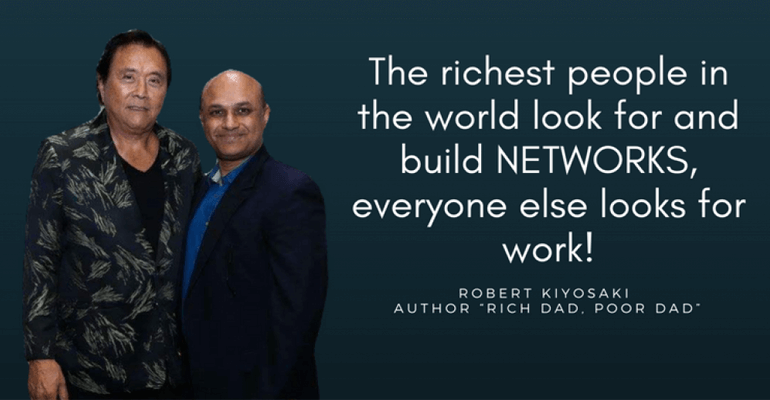
“ The richest people in the world look for and build networks. Everyone else looks for work ” If this famous quote by the celebrated author of the best-seller ‘Rich Dad, Poor Dad’ Robert Kiyosaki is not enough to make you understand the importance of networking, nothing will! He has so aptly captured the essence of networking in such few words. Given the way the world and global markets are evolving at breakneck speed today, it is no longer enough for people to just work hard to achieve success. It is now as much about working smart and who you know, so you don’t just grow, but can fast-track your growth and 10X yourself to stay ahead of the competition and get noticed. Networking is one of those simple yet effective tools, which if leveraged well, is sure to yield great returns in the long run. When I met Mr. Kiyosaki, it was clear to me that there is a guy who networked his way to the top and I learned a lot from just that one meeting. So here are 6 golden rules that can help you ace the game of networking: Determine your goal – The foremost step to figuring out how to grow your network is to know clearly what to wish to accomplish from it. Are you looking to network in order to tap the right clients for your business or do you want to find a mentor to steer your business in the right direction? Are you looking to identify good vendors to support your processes or do you want to build your network so you can get access to the right talent to drive your business? Answering these questions will be the precursor to moving ahead with the next steps to build your networks such as identifying the right forums to network and the right people to network with. Don’t be shy – This is one of the top reasons why people don’t network – because they are shy, or afraid. Bill Gates is not only a successful entrepreneur and world-renowned philanthropist – he is also considered one of the best-networked people in the world. Yes, it took him time to build his network, but he also started from a small group of individuals. People always found him reserved, ‘geeky’, but he went out of his way to overcome those stereotypes to truly network himself up. You must, therefore, make it a point to go out and introduce yourself, whether it is a social setting or a business conference. Being reserved and waiting for your potential contact to make the first move may not be a good idea since if that doesn’t happen, it will be an opportunity lost! I have built relationships with some very famous and powerful people, just by having the courage to go up to them and saying ‘hello.’ You’d be surprised how friendly and approachable they really are. Every meeting is an opportunity – The number of conferences and networking events that happen today are way more than what happened a decade back. That gives you two lines of thought: a. There are more opportunities to meet people and create contacts and b. If not at this conference, I would meet a potential contact at the next event. Probably, this is the reason why many-a-times we tend to avoid certain people in a networking setting because we believe (erroneously) that they are not the people who will be of any use to us (right now). This is, in my opinion, an incorrect way of relationship building. Utilize each networking opportunity to the best of your potential – be approachable, smile, be well-groomed, articulate your thoughts, take interest in group discussions and use it as a cue to develop a relationship. In fact, I have networked with even the so-called smallest guy in the room and built a great rapport with him only to learn later that he was the PA (and confidant) of the most powerful person in the room. So, as the old adage goes, “Do not judge a book by its cover”, you can never judge the value another person can add to your network based on their position. Follow up & follow up – While you might meet half a dozen people every single day, that doesn’t mean that you have built any relationships. The art to determining how to grow your network does not imply simply meeting, saying hello and exchanging business cards is not good enough for networking to work for you. Take the time to write a ‘thank you’ note, connect with them on LinkedIn and tell them a little more about yourself. And remember, nothing works better than setting up a face-to-face meeting so you can know each other better. If he or she is busy, it’s OK, contact them again at a later date. Research on the person a little more so that you have the relevant topics to discuss and questions to ask when you meet them. The emphasis should be on fostering a long term rapport with the person rather than making it transactional or a one-time affair. Be of service   – All successful relationships are based on equal ‘give or take’. Networking too is a 2-way street, even though you might be the one who ends the inertia. That is why it is necessary that you should not limit networking only to benefit yourself. Make an effort to see how you can add value to your connections too. In fact, your first impression will depend on what you bring to the table for others. Several famous networking clubs like Rotary International, Lions Club, and others are based on service. Use Social Networks – Last but not least, you probably already have a larger network than you even realize on your social media. So start by identifying the ones you seriously want to build a relationship with and make the first move. You must tap into your LinkedIn profile to reach out to the right people and develop those connections further for the

Scroll to Top